Hamnet: The Healing Power of Art and a Serious Oscars Contender
Spoilers ahead.
Meghan Boucher ‘26 / Emertainment Monthly Staff Writer
To see or not to see? That is the question. The answer? Definitely to see.
Chloe Zhao’s Hamnet is a movie that sticks with you long after the credits roll. And no, not because you thought it was a remake of Hamlet and misread the title. But because it’s one of the rawest depictions of grief in a movie. Based on the novel of the same name by Maggie O’Farrell, the film follows William Shakespeare’s family and the events leading up to the creation of one of his most famous plays of all time, Hamlet. Zhao stuns the audience with poignant and majestic visuals. Paul Mescal and Jessie Buckley give some of the best performances of their careers as William Shakespeare and his wife Agnes. And the combination of all of these elements creates 125 minutes of powerful, memorable cinema.
Zhao wears multiple hats in this film. Beyond directing and producing, she also helped write the screenplay (alongside Farrell) and co-edited the film with Affonso Gonçalves. Every scene, line, and cut is handled with such care you can feel Zhao’s love pouring into it from all angles.
Hamnet could definitely be a front runner at next year’s Academy Awards, but before unpacking why, a major spoiler warning is needed. Although this movie is fictional there are some core elements that are factual, which will come as a surprise to those not up to date on their Shakespearean history.
Spoilers Ahead.
This story begins with the passionate love affair of Agnes Shakespeare (Jessie Buckley) and William Shakespeare (Paul Mescal). They are young, innocent, and infatuated with each other (although it takes some convincing on Agnes’s end). Buckley and Mescal’s chemistry is off the charts in this film, as a viewer you believe in every pining moment, every loving glance, and understand why Shakespeare wrote some of the most beautiful love stories of all time. What makes it even more heartwarming is seeing the families both characters come from. William’s father is brash and aggressive, while Agnes’s only real support is her brother Bartholomew (Joe Alwyn). Their families feel devoid of love, with the exception of Bartholomew, which makes their adoration feel even more powerful.
In the film, William even harkens back to an ancient love story. He tells Agnes the story of Orpheus and Eurydice, a couple wrapped in tragedy. As legend has it, Orpheus was a musician who married the nymph Eurydice. After she dies by a snakebite, he travels to the Underworld to get her back. Hades agrees to let her go, under one condition, they walk out of the Underworld together, but Orpheus can’t look back to see if she’s following. Unable to hear her footsteps, Orpheus looks back, condemning her to an eternity with Hades.
This myth sets the stage for the tragedy that will soon unfold in their own lives. On their wedding day, as Agnes walks down the aisle, William turns to look at her and the audience knows their fate is sealed, but they still have to wait to see how it will all play out.
It’s not long after that Agnes gives birth to their first daughter, Susanna. This is where the audience starts to see how connected Agnes is to nature and spirituality. She goes to the woods alone to give birth. In a beautiful wide shot that is held for almost too long, the audience gets a glimpse into this very personal moment, which is a testament to Zhao’s influence in the editing process. She wants the audience to sit with these moments of discomfort. Buckley’s acting in this scene is superb, as well. She hones in on every moment of pain, while also showing that this moment is a way for her to reclaim her autonomy, signifying Agnes as an independent force.
Soon after, William begins to spiral. While he holds a deep affection for his wife and new born daughter, he struggles to express his creative genius and longs to get away from his abusive father.
Following the mantra, “if you love them let them go”, Agnes encourages William to go to London where he can truly express and create his art. She stays back where she raises Susanna and later gives birth to twins Judith and Hamnet.
While William is an anchor of familiarity between the audience and the film, Agnes really is the true star and beating heart. She is willing to raise three children all alone for the sake of letting her husband grow. It’s this unselfish act that speaks to the themes of motherhood in this film. Agnes is willing to do whatever she can to ensure her family’s happiness, even if it’s difficult for herself. There’s truly no better way of describing the throes of motherhood. But soon the unthinkable happens. The plague falls upon the Shakespeare household, and claims Hamnet.
Jacobi Jupe, who plays Hamnet, gives a performance at 12 years old that most adult actors couldn’t achieve in their lifetime.
He takes his job of protecting his family incredibly seriously. When his twin sister falls ill, he sneaks over to what could be her death bed and begs death to let him switch places with her. The acting in these scenes between Jupe and Buckley are absolutely heartbreaking. From Hamnet’s naive attempts of saving his sister, to Agnes’s inconsolable grief, it is a moment that won’t leave a dry eye in the house.
While the acting is enough to hold your focus, the pacing in the middle section definitely drags a bit. The balance between William’s creative life in London and Agnes’s solitary home life stretches thin. But Buckley’s acting is the tether that keeps the audience’s eyes glued to the screen and she may very well snag her second Oscar nomination for this performance. Buckley gives Agnes the depth and complexity that the character deserves. She isn’t just a grieving mother, or a wife who misses her husband’s support, but a human trying to grapple with the unfairness and cruelty of the world.
Where the movie really picks up is its final act, where the audience finally gets a glimpse into the Shakespeare the world knows so well, with the play Hamlet.
At one point, Mescal delivers the infamous “To be or not to be” speech, but not in the context of the play. He delivers it as he stands on the edge of a dock staring into the water below. What could have been a moment of pure fan service and an iconic monologue, is actually a beautiful portrait of a grieving father and a tortured artist. The precision through which he delivers the lines not only highlights his deep respect for this legend’s work, but also morphs him into the legend himself. To William, this play is an ode to his son and a way to let art heal wounds that time couldn’t quite fix. Zhao sticks with this shot for an uncomfortable amount of time as the audience watches William grapple with succumbing to his grief or letting it inspire his art.
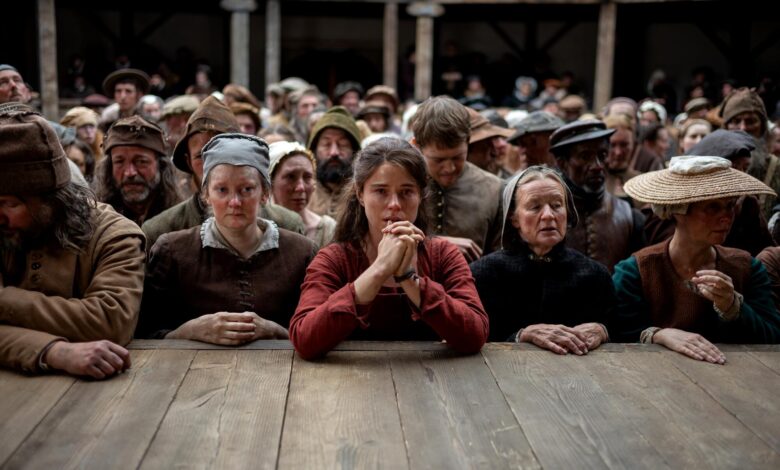
The last twenty minutes are perhaps the most stunning moments of the whole film. Agnes and her brother Bartholomew attend a performance of Hamlet. At first Agnes is enraged by the fact that William essentially left his family behind to go create this play, putting their pain on display. But she soon becomes enthralled with the beauty of live performance and loses herself in the story.
The actor who plays Hamlet in the performance is none other than Noah Jupe, the older brother of Jacobi Jupe who played Hamnet. All the casting was perfect in this movie, but this might be the best choice of them all. Not only does Noah Jupe deliver a great rendition of the classic character, but he also serves as a reminder of what could have been. The two brothers look very similar, and as Agnes watches the play, you can’t help but tell she sees her son. William takes on the role as the ghost of King Hamlet, and he and Jupe share some emotionally devastating moments together. Most parents don’t expect to lose their children. This was obviously not the case for the Shakespeare family. So to have the oldest Jupe play William’s son, it’s a heartbreaking portrayal of what should have been.
By the end of the play Hamlet dies and Buckley could have played this moment as if it was like losing her son again, but she doesn’t. Instead she extends her hand to the actor on stage and the rest of the audience follows suit. With tears in her eyes she laughs and the play concludes.
It is such a powerful moment in the film, as everyone is moved by the power of live performance. What’s particularly interesting is a core element of the Hamlet play is the idea that art moves people in ways that most other things can’t, which is exactly what the audience bears witness to in this scene.
By seeing what subconsciously is supposed to be an older version of her son, Agnes is able to let go of some of that grief and start to heal. It wasn’t until she saw the play, the very thing William channeled all his grief into, that she was able to let go of some of that resentment and anger.
Despite the central themes of the movie being about death and grief, Hamnet is the kind of movie that makes you want to live. You leave the theater feeling a new found joy in the world, even though it can be filled with such heartache. This paradox is only achieved because of the commitment of Zhao to tell this story faithfully and the work of the actors to create a mosaic of art, pain, grief, and love. Hamnet asks:what if one of the most famous men in history wasn’t the center of his own story? It shows the importance of the untold moments because that is where true transparency shines through. Just as art helped to heal the Shakespeare family, Hamnet is a masterpiece that will captivate audiences for years to come.