‘Wake Up Dead Man’ is a Religious Experience (Literally)
Jackson Gagliardi ’27 / Emertainment Monthly Staff Writer
With one of the most unnecessarily long titles in filmmaking history, Wake Up Dead Man: A Knives Out Mystery is, as the name implies, the latest installment in the Knives Out saga. With Rian Johnson returning as writer/director and Benoit Blanc (Daniel Craig) back on the case, this latest whodunnit sees all the familiar hallmarks of previous films return: a star-studded ensemble, plenty of rug-pulls and switcharoos, and Blanc’s charming Southern drawl.
On the whole, the film is a synthesis of the prior films. Yet even with the tight-knit but tense community and set design perfect for a Pinterest board of Knives Out (2017), mixed with the culturally poignant commentary and comedic underpinnings of Glass Onion (2022), Wake Up Dead Man unfortunately underperforms on both fronts.
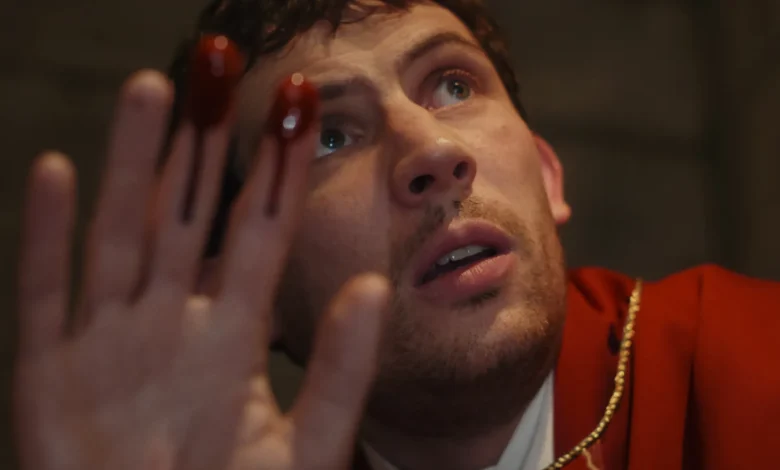
The film follows Reverend Jud Duplenticy, a former boxer turned priest excellently portrayed by Josh O’Connor. Duplenticy is one of the most complex characters in the Knives Out saga yet, and O’Connor delivers on this nuance, lacing every scene with tangible internal conflict. After punching out a fellow priest for saying something he didn’t agree with, Father Langston (Jeffrey Wright) sends Duplenticy to a small town in upstate New York to assist Monsignor Jefferson Wicks (Josh Brolin), a controversial and adversarial figure whose hateful rhetoric has curated a small cult-like group of subscribers. This group houses a loyal church lady and Wicks’ number one fan in Martha Delacroix (Glenn Close), a self-proclaimed “wife-guy” without a wife in Dr. Nat Sharp (Jeremy Renner), a successful lawyer carrying on her father’s legacy in Vera Draven (Kerry Washington), a failed politician turned influencer (and Vera’s adopted son) in Cy Draven (Daryl McCormack), a washed-up sci-fi author in Lee Ross (Andrew Scott), a former cellist with chronic pain in Simone Vivene (Cailee Spaeny), and a church groundskeeper in Samson Holt (Thomas Haden Church).
While this variation in characterization might sound like his most complex crew yet, not all characters were created equal, and some exist as mere cardboard-cutouts of actual people. This disappointing turn leads the entire mystery to feel off-balance, as some characters clearly get a lot more attention than others, leaving the audience’s internal suspect list low.
Despite this, the mystery itself functions quite well as an homage to things that came before it, and this meta-textual throughline is acknowledged throughout as characters make blatant references to the mysteries this one emulates. In the post-screening Q-and-A shown at Alamo Drafthouses, Johnson mentioned not only a clear respect of Agatha Christie, but a direct desire to carry on her mysteries’ essence by telling original whodunnit mysteries in a contemporary setting. This intertwined awareness of the cultural context in which the mystery occurs is arguably the film’s best aspect, touching on the dangers of social media, the villainization of religion, and many other topical aspects.
The film also reflects Johnson’s personal relationship with religion, which is—as one would expect—at the very core of the film. Johnson explained that Christianity was a big part of his life into his twenties, and being within that group informed the way he portrayed every character’s reckoning with the religious construct.
At the end of the day, it’s another Knives Out mystery, and any original film capturing this large a segment of the cultural zeitgeist is important. Each chapter of the series is a marker of a specific time in our culture, with both an exciting cast and a mystery that gets people talking. Wake Up Dead Man was the last film slated as part of Netflix’s deal with Johnson, and, therefore, there’s no official confirmation of a possible Knives Out 4.
Still, despite its shortcomings, Wake Up Dead Man should not be the end. In fact, it should only be the beginning.