What’s Wright and Wrong With ‘The Running Man’
Dylan Z. Alter ‘29/Emertainment Monthly Staff Writer
The Running Man has been revived.
Written in 1982 by Stephen King—under the pen name of Richard Bachman—The Running Man is a novel about a man competing in a deadly game show. In 1987, it was adapted into an action blockbuster starring Arnold Schwarzenegger, but after that, the reality sensation would lay dormant for years.
That is, until this year, when The Running Man was picked up for a revival.
This time around, the film was written and directed by Edgar Wright, creator of the Cornetto Trilogy and action hit Baby Driver. Characterized by his use of licensed music, smooth tracking shots and off-the-wall humour, Wright’s vision of the film seemed to fall more in line with the likes of Baby Driver than with Sean of the Dead, being a fairly straightforward action film.
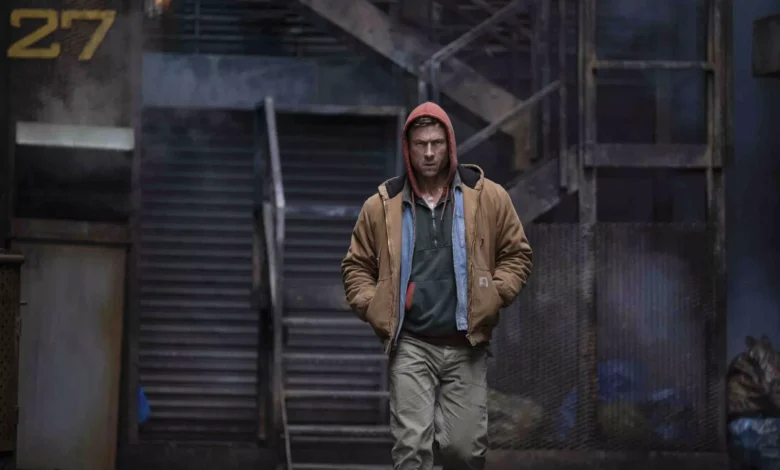
The film stars Glenn Powell as Ben Richards, a working-class man from “Slumside,” the poor neighbourhood of this dystopian world. While Richards’ daughter is sick with the flu, he is blacklisted from working in the city, having been part of several worker revolutions in his past. Desperate to make some money to afford the medicine his daughter needs, he auditions for several popular game shows hosted by the Network, a mega-corporation that controls not only all television content, but has sway with the United States government.
Ben gets cast in “The Running Man,” the most dangerous game show of all. His task is simple: survive for thirty days with the entire country hot on his tail, all while recording ten minutes of video footage for the TV show to air every day and depositing it in a company mailbox. While in hiding, he is being tracked by an elite group of hunters—trained gunmen selected specifically to find and kill the runners. Runners can also be filmed and reported to the hunters by members of the public if they happen to see him.
Ben’s run takes him across the entire East Coast, from New York to Boston to Derry, Maine (a frequent location of King’s). Along his way, he encounters several people who help him get from one place to the next, and even more who want to kill him. He also sees his public image shift dramatically, from negative to positive; when he first appears on “The Running Man,” his image is slandered to make him seem like a deadbeat who abandoned his family for cash. However, the more he survives, the more people begin to root for his success, and the more the public opinion of the Network begins to take a negative turn.
Largely, the film is enjoyable. It’s well paced, very well shot, and Powell’s acting is gripping and humorous in equal measure. Wright’s more cinematic style that he began to develop with Baby Driver is on full display, with his precision and affinity for interesting shot composition being standouts. There are even a few of his textbook visual gags, such as a scene where Ben’s movements mirror those on a billboard right behind him.
The one place where it seems like Wright held himself back in favor of a more generic approach is the film’s score. Wright’s films are usually filled with licensed music—creating a soundscape that perfectly reflects each scene’s mood—and a stellar use of diegetic music to enhance character moments. That is all gone in The Running Man, with the film being scored entirely by original music. It would have been nice to see some more songs, as the current film feels somewhat like an artificial recreation of Wright’s style, taking the visuals and eye-catching moments without the substance of his other projects.
However, there is a lot more wrong with the film than its music, in particular the entirety of its third act. After one explosive sequence in which Ben encounters a rebel named Elton (Michael Cera), the plot begins to fall apart. Ben hijacks a car belonging to Amelia (Emilia Jones) and forces her to drive him to an airport, where he demands that the Network give him a plane to bring him to the Canadian border—or he will kill them all.
They oblige, and, upon bringing him on board, Dan Killian (Josh Brolin), the head of the Network, offers him a job as a television star. He says that Ben’s public image is so good that millions would watch if he had his own show where he became a hunter.
While Ben tries to say no, Killian shows him a video of the hunters killing his wife and daughter. This sends Ben into a fit of rage, and while he attempts to take control of the plane, Killian feeds the world a faked video of Ben saying he wants to kill everyone, before redirecting the plane towards the Network building.
However, right before the plane can hit the building, it is blown up, leaving Ben dead.
That is where the book ends, though, on the page, Ben is the one to drive the plane into the Network building (and he succeeds). Yet the film chooses to continue from this point: As it turns out, the video of Ben’s family being killed was a fake, and Ben also survived the plane crash. In the end, the people of the world revolt against the Network, and Ben shoots Killian in the head.
The film’s final thirty minutes completely crumble. Ben, up to this point, has actively rejected playing into the network’s persona of him, only doing so when he knows that they will fake anything he says on air. However, the second Elton is killed, he just starts playing up his persona and kills indiscriminately. Each time it seems like the film is going to end, it keeps going, and each time the point gets more and more muddled.
Ultimately, a revolution occurs that seems to topple the Network, but it’s unclear why Ben was such a catalyst when the show has been going on for years. None of Ben’s anti-Network rhetoric was actually shown to the public—only the parts of him being cruel or violent. It doesn’t seem like Ben’s actions had any impact, since most of the things he did and said were deepfaked and altered by Network executives, or never aired on the show.
Overall, it isn’t hard to enjoy The Running Man. At times, it feels like a good episode of reality TV, filled with overly dramatized characters who each get booted when the showrunners say their time is up. Sadly, the ending falls apart completely, and leaves fans unsatisfied with the whole affair.
While there is a lot right with The Running Man, there is also a whole lot wrong.