Yes, ‘Tales From Topographic Oceans’ Is Back – And More Overstuffed Than Ever
Dylan Z. Alter/EM Staff Writer ‘29
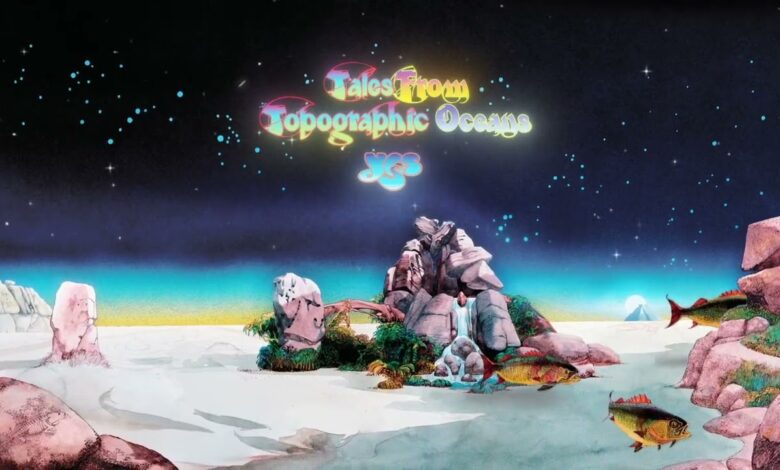
Over 50 years ago, progressive rock reached the peak of indulgence. Having just completed their fifth record Close To The Edge, progressive rock group Yes returned to the studio with renewed vigour and a brand new idea. While on tour to promote the album, lead singer Jon Anderson conceived of a record inspired by the spiritual work Autobiography Of A Yogi. Upon returning to the studio, the band spent the following year compiling together four songs that would make up their new, almost 90-minute album.
Tales From Topographic Oceans released in December of 1973 to overall positive reception, with many noting that while the songs were good, they were incredibly long, and many felt overstuffed.Now, in 2026, Tales is back, and filled to the brim with new material.
Announced in late 2025, Tales From Topographic Oceans: Super Deluxe Edition is a behemoth of a special edition, containing within its twelve discs over ten hours of music to enjoy. Porcupine Tree’s Steven Wilson, a rock musician who has done several remasters of classic prog music, lends his talent to this collection, providing an updated remix of the original album, taken from an earlier remix released in 2018, also by Wilson. He also provided instrumental versions of said remixes, allowing for the soaring compositions to be heard in all their glory. From there, listeners can enjoy trimmed-down, single-length sections of each of the four songs, as well as multiple demo versions of each track, with unfinished lyrics, vocals, and some interesting differences from their finished counterparts.
Finally, several live versions of the songs are present, compiling two performances from across the UK, recorded in 1973, as well as a complete recording of the band in Switzerland recorded in 1974. All told, this new version of the album allows for many ways to enjoy the four songs, but it raises the question: how have these songs held up in the new millenia?

The Revealing Science Of God (Dance Of The Dawn)
The opening song, “The Revealing Science Of God”, has one immediate major difference depending on which version you are listening to. When the original track was released, it came in at a length of around twenty minutes, and this length is preserved in the remaster. However, the Steven Wilson remix and earlier rereleases put this song at a length of over twenty-two minutes. When the song was initially being recorded, there were two minutes of introductory noise and synth chords before the vocals kicked in, and these were removed on release to save time. Wilson chose to add these extra minutes back to the beginning, and the song is far better for it. As Jon Anderson discusses the beginning of life, and humanity’s “dance from the ocean”, a drum pattern gets louder and louder until the song bursts forth into its upbeat second movement—there are five in this song—and introduces a guitar riff that will return throughout the rest of the album.
As an opener, this song is incredibly effective at setting the tone, and fans of prog will adore the length and depth of the song’s composition. Those not used to songs of this length may prefer the single edit, which contains the song’s fourth movement and comes in at a more reasonable four minutes. Either way, this song soars and swells just as much as it relaxes and soothes, and makes for an incredible listen both on its own and with the rest of the album.
In the “Super Deluxe Edition,” there are three unfinished demo tapes of this song, the longest of which comes in at twenty-seven minutes. While each demo has new, unfinished vocals, the instruments are all in a fairly complete state, and none can match the original song. They are worth checking out for avid fans, but new listeners may want to look elsewhere.
Sadly, only a few of the live versions included on this edition are included in their entirety. The recording quality of the live versions is also rather poor, with the vocals, particularly the harmonies, getting lost in the instrumental noise. There is only one live recording of “The Revealing Science of God” present in this collection, and it has the same issues as the other live recordings in this edition, making for an inclusion that fails to bring much new to the listening experience.
The Remembering (High The Memory)
The second song on the album —and running for twenty minutes—“The Remembering” starts slower than “The Revealing Science Of God”, and is largely more relaxed. Opening with a simple, flowing movement, including some lovely harmonics and synths, the song picks up in intensity before switching into an ethereal synth solo to introduce the second movement. The second movement ups the energy, reintroducing the drums and introducing a peppier melody. Once again, the song slows down, and this pattern continues through the rest of the song, with the midsection introducing two brand new melodies, but always maintaining the pattern of picking up the pace and slowing down.
“The Remembering”, while ironically less memorable in places than other songs on the album, stands just as strong as the rest when viewed as a part of the whole experience. For those looking to simply dip their toes into the world of the song, the single edit provides a snippet of one of the middle movements, and comes in at only three minutes, making it perfect for those with little time to devote to the complete epic.
The demo versions of this track are largely the same as the final release (with the only difference being the lyrics and vocals), meaning much of the additional compositional process is absent from these demos. However, while there is only one live version of this song, it stands as the best live song on the album. The vocals are strong and forward, while still allowing the instrumental to be heard, and the recording has minimal crowd noise and audio effects muddling the sound. Very worth the listen.

The Ancient (Giants Under The Sun)
The third song on the album, and the first song on the second disc, “The Ancient” is easily the weakest composition of the bunch. It is the shortest, running for only eighteen minutes, but it is also the least coherent, repeating the same series of riffs and beats over and over without much variation. Compared to the rest of the album, each movement is largely the same, and very little of it is compositionally interesting.
However, around the twelve minute mark, the song dramatically changes style, and the end of the song is one of the best moments on the entire record. It is simple — with just guitar, synth, and vocals — but the melody and lyrics are beautiful, going through the seasons and touching on elements of life and worldly beauty. While the majority of the song is rather boring, these last several minutes (which comprise the single edit) manage to make the song not entirely painful to listen to. It can’t fully save the song, but it tries.
“The Ancient” serves to bridge the gap between the first and second discs well enough, but on its own it is very weak. With a series of weak live recordings, in which the band extends and jams through much of the first 90 percent, the song adds very little of value to the collection.

Ritual (Nous Sommes Du Soleil)
The final song on the album, and easily the greatest, “Ritual” is an incredible closing number. It kicks off with a peppy, guitar-heavy instrumental section, before settling down into a beautiful verse with the repeated refrain “Nous sommes du soleil” (we are of the sun). The song swells and soars, comes crashing back down to mellow out, and maintains a constant energy despite containing little melodic variation. Towards the end of the song, a five-minute Alan White drum solo tears through and connects the end to the beginning, returning to the main melody before fading out into silence.
This song is worth listening to on its own, but when combined with the surrounding pieces it is absolutely stellar.
“Ritual” is the only song in the collection to have two single edits. The first pulls from the middle section, a particularly high point, while the second takes from the end. Each runs for about three minutes, and while they are both good snippets from a great song, neither can replace the complete version. However, the second live recording included of “Ritual” is one of the few live recordings in the collection to showcase the song in its entirety, making the best song on the album even better.
Conclusion
So how does Tales From Topographic Oceans hold up 50 years later? Very well. Each of the songs has something to offer, either separately or together. The remasters, particularly Steven Wilson’s remixes, make these songs feel fresh again, and show just how much technical prowess the band was capable of.
However, beyond the remixes and instrumentals, the new collection leaves much to be desired. The demo versions of these songs are so similar to their finished versions as to be indistinguishable at points, and the live recordings suffer from poor recording quality. As a collector’s piece, the collection is stellar, and for those willing to foot the $120 price tag to hear their favorite tracks in a new way, the collection is worth it. For those looking to get into the album for the first time, it might be best to avoid this collector’s edition.
Regardless, anyone who has yet to listen to Tales From Topographic Oceans is missing out on one of the greatest, most indulgent records of all time. With a fresh remaster, there is no reason to avoid it any longer.