Frederick Ashton’s The Dream Comes to Boston
Gray Gailey ‘27 / Emertainment Monthly Staff Writer
From March 19th to the 29th, thousands of theatergoers filled the Citizens Bank Opera House in Boston to watch a two-part program featuring Sir Frederick Ashton’s The Dream and the world premiere of Boston Ballet artist-turned-choreographer My’Kal Stromile’s The Leisurely Installation of a New Window.
The program opened with Stromile’s The Leisurely Installation of a New Window. And, leisurely it was. The audience is introduced to a young woman reading a book on an empty stage, save for a gray screen draped behind her. The dancer commands the room immediately with a delicate solo dance, followed by a series of playful group dances, as her book is traded between the ballet artists. The fifth dance is a romantic duet full of drama and tension, representative of the tension that had been slowly building throughout the work.
“A major part of Boston Ballet’s mission is to propel the dance world forward through the creation of new work,” says Boston Ballet’s artistic director, Mikko Nissinen, in the program notes. “Boston Ballet commissioned The Leisurely Installation of a New Window to celebrate the future of our living art form at this pivotal 250th moment in America.”
Choreographer Stromile studied at The Juilliard School and has danced with Bruce Wood Dance, Disney Productions, and Boston Ballet. His work attempts to blend classical ballet with modern music and dance influences. While thoughtful and intellectually ambitious, this particular program falls short. The performance builds gradually, but never fully comes to a head, and the dances lack emotional cohesiveness. According to program notes, The Leisurely Installation of a New Window is broken into three movements: Thesis, Antithesis, and Synthesis. The work explores how different people operate within broken social systems. Three roles emerge: The Seekers, who strive for balance, logic, and coherence; The People, who adapt fluently; and The Reformers, who attempt to change the existing conditions. Some keen audience members may have picked up on this, but the concept was certainly not spoonfed to them.
What does stand out about this performance, however, is the music. Boston Ballet music director Mischa Santora worked with Reeves Gabrels, guitarist for The Cure and David Bowie, to create a unique sound that blended classic orchestral sounds with striking electric guitar chords. The music fluctuates between dramatic string instruments and zippy, thrilling beats featuring the guitar, which create an absolutely stirring effect.
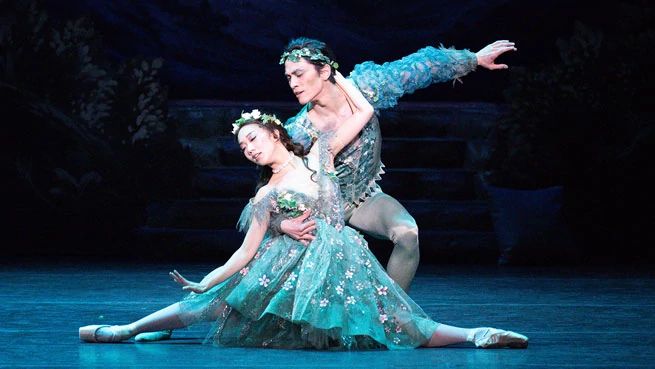
After an intermission, the stage transforms into the familiar world of William Shakespeare’s A Midsummer Night’s Dream: dark green forests, a moon shrouded by clouds, vines and flowers bursting up unexpectedly. Where The Leisurely Installation of a New Window is deliberately abstract, The Dream is deliberately cheeky.
The ballet begins with a quarrel between Oberon, King of the Fairies, and his queen, Titania. Oberon commands his mischievous sprite, Puck, to fetch a magical flower. This flower, the audience comes to learn, lulls its victims to sleep. When they awaken, they fall in love with the first living creature upon waking. Of course, Oberon hopes to utilize the flower to compel Titania into loving him again. However, Oberon and Puck’s plan quickly falls apart, setting off a chain reaction of romantic mishaps and mistaken affections.
The performers lean fully into the story’s comedic aspect, with dramatic facial expressions and purposefully clumsy movements. Two young couples and their entangled affections weave on and off stage, evoking laughter from the audience. When one villager turns into a donkey (who miraculously dances en pointe), Titania, under the spell of the magic flower, stumbles upon him and falls in love, much to Oberon’s chagrin—but much to the audience’s entertainment. In the ensuing chaos, fog floods the stage (and orchestra) as the characters quarrel.
Eventually, Oberon orders that the spell be reversed, and harmony is restored. Queen Titania returns to her King, Bottom returns to his human form, and the confused couples rightly reunite.
The piece is full of mischief, whimsy, and humor. The dancers sell every movement and moment, transporting the audience directly into the midst of the chaos. The music, written by Felix Mendelssohn and arranged by John Lanchbery, is more traditional, though it includes brief bursts of energy and even operatic scales. It heightens every aspect of the continuous drama.
Choreographed by Sir Frederick Ashton, best known for The Dream, Cinderella, and Romeo and Juliet, The Dream premiered in 1964 at the Royal Opera House in London. This is the first time the story was told on stage in Boston.
Despite the dissonance between The Leisurely Installation of a New Window and The Dream, the program succeeds in the strength of its performers. The dancers, hailing from San Diego to South Korea, demonstrate raw talent and commitment to their craft. Whether one could follow the plot or not, it was easy to stay engaged by the dancers’ form, finesse, and facial expressions. Many of them will be returning to the Citizens Bank stage on May 28th through June 7th for Marius Petipa’s The Sleeping Beauty.