Hoppers Review: One Hop Back, Two Hops Forward
Shastine Matsunaga Nol ‘26 / Emertainment Monthly Staff Writer
Spoilers Ahead.
There is nothing quite like a movie that makes you feel like a kid again. Similarly, there is nothing like a movie that is silly, heartfelt, and—more than anything—just plain fun.
On the outside, Pixar’s latest outing Hoppers is exactly this: an entertaining and goofy journey of one girl fighting for something that matters deeply to her. But within the narrative, there are also pockets of genuine emotion that make the movie just grounded enough to connect with the audience like Pixar movies always used to do.
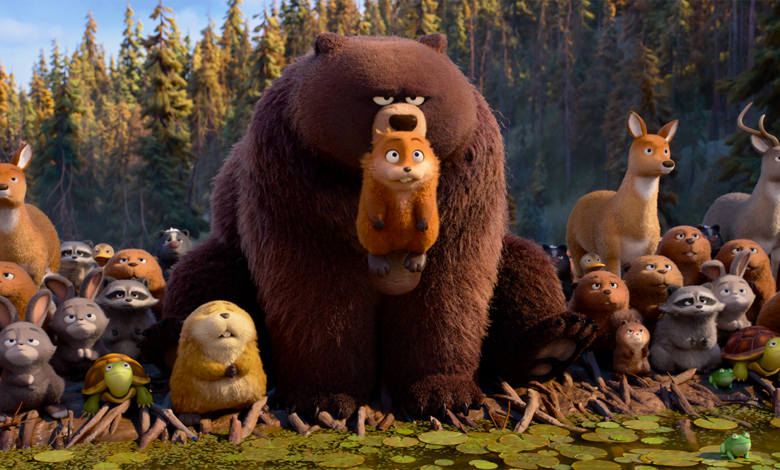
The movie follows Mabel (Piper Curda), a 19 year old college student who fights to protect a forest glade she frequently visited as a kid with her late grandmother (Karen Huie). When she discovers an experiment run by her professor, Dr. Sam (Kathy Najimy), that puts a human brain into realistic animal robots, Mabel hijacks the technology and inhabits a robot beaver in true Avatar style (despite Dr. Sam’s insistence to the contrary). Utilizing this technology, Mabel sets out on a quest to save the forest glade from the city’s mayor Jerry (Jon Hamm) who plans on destroying it to make way for his highway.
For how goofy the movie can get, Mabel is an incredibly grounded and relatable protagonist, and her motivation for protecting the glade is rooted in a deeply nostalgic place. Her grandmother, the only person who truly took the time to understand her growing up, brought her to the glade for the first time, and over time, it became a profoundly personal place for her. This connection causes her to double down on saving the glade, but also lose sight of what is really important in the process.
We all develop emotional attachments like this, and like Mabel with the glade, we can lose sight of what’s important when we cannot bear to let go of even the smallest amount.
On the opposite end, Jerry is a very one-sided antagonist, being a very clear symbol of corporate greed. This is not a bad thing, however. His characterization fits the tone of the movie well: incredibly unserious, but still eliciting enough of an emotional response from the audience. It is actually fitting that he is so exaggeratedly one-sided and self-centered for the majority of the film, because it perfectly reflects how Mabel’s rivalry with him—driven by her desire to save the glade—is as one-sided as him.
While her motivations are certainly more noble, the way she attempts to obtain what she wants is reflected by the way Jerry mercilessly ransacks the glade for his own personal gain.
When Mabel first inhabits the robot beaver, she immediately gets to the task of finding a real beaver to bring to the glade which would then restart the ecosystem, as Jerry cannot legally continue work on the highway if it will result in the deaths of animals. But when Mabel attempts to get a beaver to the glade, she immediately disrupts the flow of the ecosystem by breaking the “Pond Rules” that allow all of the animals in the area to coexist in peace. She becomes so single-mindedly obsessed with saving the glade that she neglects to see what the animals actually need, just as Jerry becomes so single-mindedly obsessed with his highway project that he ignores the emotional pain of those his project will affect.
In the midst of all of this, another antagonist emerges from his cocoon. Literally. Titus (Dave Franco), a butterfly and the new insect king (after his mother was accidentally smushed by Mabel earlier in the movie) decides to destroy all of the humans. He is motivated, not only by his greed and pride, but also a speech Mabel gave earlier in the movie to encourage the other animals to help her stop Jerry. She encourages the animals to fight back against the oppression of humans like Jerry, but, as a result, encourages Titus to put his evil plan into action and take over both the human and animal kingdom.
Titus is effectively Jerry taken to the extreme, which is telling of the depth and quality of his character (as Jerry himself lacks emotional depth by design). Thus, Titus feels almost out of place. He shows up seemingly as a bit earlier on in the film, but is treated with so little respect that when he ultimately becomes the big bad at the climax of the movie, it feels like it came out of nowhere. Even Jerry helps in the fight against Titus, which feels like a complete heel turn from everything leading up to that point. If there is one main complaint to be had with the movie, it is with Titus, who, while being extremely entertaining, is a weak antagonist that ends up trying to overshadow the film’s themes more than anything.
In the end, Mabel helps the animals destroy their dam so that a massive forest fire will be put out and their home will be preserved, and a reformed Jerry converts the glade into a wildlife preserve. Ultimately, the final shot of the movie shows that Mabel has changed significantly. As we see her sit next to her new beaver friend George (Bobby Moynihan) on the same rock she would sit with her grandmother, we see that she values the connections she has made as much as the glade itself, and realizes it is those connections that make the glade special in the first place.
Only when Mabel was able to form a connection again—even if it was with a beaver—was the glade able to thrive once more.
Because of how relatable Mabel’s pain is, it is easy to immediately want her to succeed in saving the glade. After all, the audience goes on the journey with Mabel, experiencing emotional growth as she does. But while Jerry is objectively wrong, that does not mean that Mabel is objectively right, no matter how much we wanted her to be. This is the strength of Pixar’s writing, a strength we unfortunately don’t get to see much anymore. In the past, Pixar has excelled at making the audience experience the same emotional growth of the character—learning the true spirit of competition alongside Lightning McQueen, and harnessing the power of expressing all of our emotions alongside Joy and Sadness. Here, once more, we learn that what we think is best for the people (or animals!) we care about may not be what they need or want, and we need to be able to (in this case, quite literally) see things from their perspective to understand what they actually need
Because of this, Hoppers is a delightful movie packed full of classic Pixar charm and references. Its excellent themes and storytelling shine despite its goofiness and occasional jumping of sharks, and proves that there may just be hope yet for Pixar’s immense creative potential.