The Green Comes to Gotham: A Batman: Bad Seeds Review
Olivia Lindquist ’26/Emertainment Monthly Staff Writer
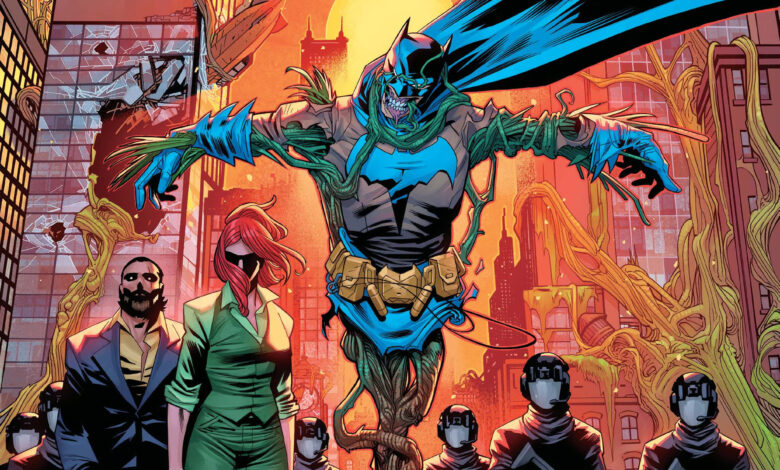
Batman: Bad Seeds was an ambitious event used to unify the titles in the Gotham group of DC comics. Boasting a 10-week run, 24 issues, and 12 creative teams headed by G. Willow Wilson and Matt Fraction, Batman: Bad Seeds has had fans in a tizzy trying to collect all the issues to stay on top of the story unfolding. DC is no stranger to wide events, most recently D.C.K.O. concluding March 2026 and Justice League Unlimited’s “We Are Yesterday” arc that concluded in June 2025, but it’s been a while since DC has done a Gotham-specific event that would lead to so many crossover issues (most being two-parters). The last time Batman and related characters were in such a large crossover event was the 2021 Fear State event that came at the tail end of James Tynion IV’s Batman run. The anticipation for Bad Seeds comes after a rough summer for DC Comics fans, and expectations were high with Wilson and Fraction’s partnership.
The prelude to the event began with Poison Ivy #47 in which Pamela Isley (Poison Ivy) is cornered into turning Gotham over to The Green—a supernatural force that controls and connects all plant life—in order to avoid accountability for murder from the Parliament of Trees—a governing body of The Green—and to avoid getting murdered by Vandal Savage. Already, this event begins with lots of moving parts and the Gotham editorial team had their work cut out for them.
In the following issues, the quality waxes and wanes, but the story stays strong. Fraction and Wilson set up the countdown to sunrise and give us our key players: all the bats and bat related entities (though the Foxes are suspiciously absent), Ventriloquist, Anarky, James Gordon and his partner Officer Espinoza, Harley Quinn, Tim Drake and his boyfriend Bernard, and Waylon “Killer Croc” Jones. The only bat-related entity not included in this event is Barbara Gordon’s Batgirl, who was arrested by Vandal Savage to figure out how enemies of Savage keep dying in Blackgate Prison; her narrative continues in her own solo, Barbara Gordon: Breakout.
Matt Fraction’s Batman run, which spanned 12 issues prior to the start of the event, hasn’t been received very well, and when Bad Seeds puts him and G. Willow Wilson side by side it couldn’t be more obvious. His writing on Batman and the combined issues of Sunset and Sunrise isn’t terrible, but it relies heavily on drawn out action scenes rather than actual substance on the page. His issues for Batman in this event were intentionally slower paced and often used to fill space while the other characters included in the run were operating with their own arcs. Part of this problem can be attributed to having to share the narrative line with Detective Comics under Tom Taylor—another divisive writer among fans—but Taylor’s Detective Comics issues didn’t suffer the same lagging, even the one that was split into two for a one-shot issue revolving a Sweepstakes Villain.
The story is also lacking in Tate Brombal’s Batgirl issues. A two-part inclusion to the event, Batgirl #23 and #24 follows Cassandra Cain as Batgirl in this newly-evolved Gotham fighting to get a poisoned little girl across the city to the Gotham General Hospital after being stabbed. While a character like Cassandra should have a lot of introspection, what was on the page was very elementary for a character as complex as her. She’s evolved from her first appearances, and yet, in these issues, her inner narration still lacks nuance and depth. It unfortunately echoes concerns fans have with Brombal’s run as a whole—which is disappointing because the current Batgirl run is the first Cassandra solo since her last run ended in 2006.
The rest of the crossover actually meets the high expectations set by the editorial and marketing teams. Though Batwoman and Harley Quinn are painfully mid, they fit very well into the narrative and balance out some of the bad from Batman and Batgirl. Both operate with two-part arcs, with Batwoman’s following her acquiring Batman’s hidden stash of technology underneath the Church of St. Dumas and encountering Savage’s militia and Huntress, and Harley Quinn’s following her journey through Gotham in an attempt to find Isley, despite a bounty hunter nearly killing her. They’re good examples of the varied tones within the Gotham Group, as Batwoman operates in a much darker and more gothic atmosphere as compared to Harley Quinn’s brighter, more comedic approach.
Three new mini-runs came out of the event as well: Streets of Gotham, written by Matt Fraction and Mariko Tamaki; Gotham Central, written by Christopher Cantwell; and Gotham General, written by Greg Rucka. Streets of Gotham was a Week 8 release featuring a series of short events following Signal (Duke Thomas) as he saves people across the city. Tim Drake and his boyfriend Bernard appear as well, and there is also a short story following a group of kids dressing up as Batman to fight the plant monsters outside. It was a nice respite between the intense issues of Gotham Central #2 and Batwoman #8. Gotham Central follows Gordon and Espinoza as they investigate a murder leading them to track down Victor Zsasz and Ankika Zeller on a train. There, they cross paths with Spoiler/Batgirl (Stephanie Brown), Harvey Bullock, and Officer Baker. An explosion knocks the train off the tracks and gravely injures Spoiler/Batgirl, but events converge in Gotham General. Gotham General was originally meant to be released alongside Gotham Central #1 on Week 3, but was pushed back to Week 10 with its second part releasing November 25th. Gotham General is an intense medical drama that keeps the reader hooked from start to finish.
The true gemstones of this event are Catwoman, written by Torunn Grønbekk, Detective Comics, written by Tom Taylor, and Nightwing, written by Dan Watters. Catwoman, though removed mostly from the typical Bat activities in the run, pursues heroism in her own way by putting her life on the line to make sure the son of Gotham City’s DA gets home safe. It’s proof that Selina Kyle will always be a complex character with emotional depth that her male counterparts do not always possess.
Detective Comics is also where readers see the most plot happening outside of tie-ins and one-shots. Batman actually solves problems in these two issues (#1113 and #1114) and behaves like Batman would, while in Batman, Robin and Verity—the ten-year late replacement for Alfred—do the heavy lifting. In Detective Comics, readers get to see a Batman who is compassionate and actually wants to help people, not one who just wants to throw hands. It’s refreshing to see after 14 issues of Batman under Fraction, who seems to forget Batman is inherently a compassionate being.
Nightwing is an arc about brotherhood featuring a fan-favorite relationship rekindling as Robin (Damian al’Ghul-Wayne) and Nightwing (Dick Grayson) reunite for the first time properly in years. Readers are reminded of Dick’s stint as Batman as he copes with the fact that he’s missed his littlest brother growing up since he distanced himself from Bruce, especially with the events in Watters’ current run outside of the event. It’s wholesome, and readers get to see them care about and for each other in a way superhero comic books usually neglect.
All of these stories and arcs have one thing that ties them together and that’s the persistent idea of hope. Hope for one’s people, for one’s home. Even if it took a while to get there, each of the featured characters are inspired by a hope for something better. The most obvious comes across when it’s stated blatantly in Gotham General, but it’s also a thought that resonates throughout the finale, Sunrise. Whether it’s Vandal Savage, Darkseid, or even DC editorial, one thing’s for certain: Gotham endures.