Lily Allen Bares All On Her ‘West End Girl’ Tour
Gray Gailey ‘27 / Emertainment Monthly Staff Writer
Lily Allen’s ‘West End Girl’ tour has sparked an online debate about how much we should expect from our favorite musicians. Many fans have taken to TikTok to complain about Allen’s setlist, which is limited to her new album, West End Girl, and features no “surprise songs” or tunes from her back catalog. She also sticks to a tight schedule, leaving absolutely no room for stage banter or monologue.
The album—the singer’s fifth—was released in the wake of Allen’s divorce from Stranger Things star David Harbour, and documents Allen’s turbulent emotions throughout this period. Allen takes listeners on a journey as she uncovers her ex-husband’s secrets, spirals, hits a low, and eventually begins to heal. Now, she’s taking that story on the road, across the United States, Europe, and Australia, in a show that reads more like a cathartic retelling than a typical concert.
At Boston’s Orpheum Theatre, Allen’s opener—another frequent topic of debate—was the Dallas Minor Trio, a three-person cello group named after Allen’s song, “Dallas Major.” The Dallas Minor Trio began right on time, performing instrumental renditions of ten Lily Allen songs, including fan favorites such as “Smile” and “LDN”. Song lyrics were displayed behind them and audience members were encouraged to sing along karaoke-style. The crowd—a mix of genders and ages, friends and lovers—took to the challenge, and were especially loud for Allen’s girlhood anthem “Unfair” and, of course, her 2009 hit “Fuck You.”
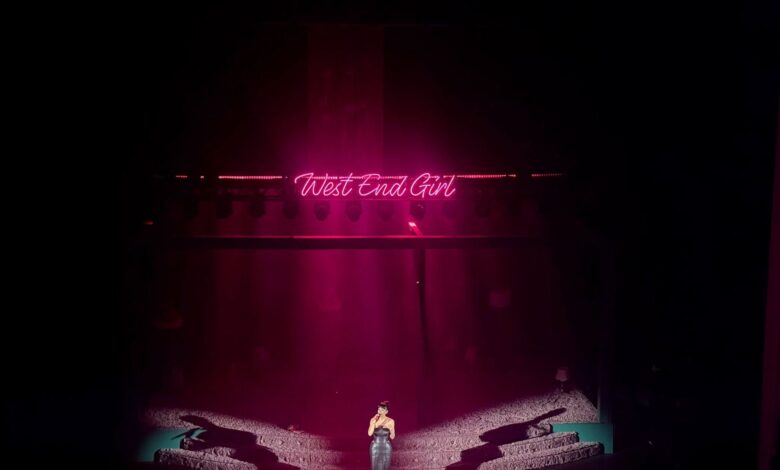
Roughly twenty minutes after the Dallas Minor Trio took their bows, the house lights fizzled and popped until the stage—and Allen—revealed themselves. The set looked like it had been lifted straight out of London’s West End: The stage mimicked a 70s-style house, complete with a fuzzy pink carpet, retro fridge, and a red dial phone, and was illuminated by dramatic chandeliers and marquee bulbs.
Allen’s set list followed the album in chronological order, adding to the ‘storytelling’ feeling. Title track “West End Girl” laid the foundation for the ensuing drama, while songs like “Tennis” and “Madeline” produced feelings of confusion and paranoia. After a brief set change, the tone shifted. The second act kicked off with “Pussy Palace,” in which Allen poured props such as sex toys, condoms, and lube onto the stage (all of which, as she mentions in “Pussy Palace,” she found in Harbour’s apartment). Closing tracks “Beg for Me,” “Let You W/In,” and “Fruityloop” turned the energy down, but provided a glimmer of hope for Allen’s future as a single woman.
Throughout her set, audience members shouted “Fuck Stranger Things!” and “You go girl!” in support of the singer. Others were busy comforting their friends, who related a bit too much to Allen’s lyrics.
Allen’s outfits were an important component of her set. While the singer opened the show in a retro housewife skirt suit, she stripped herself down—emotionally and literally—until she was clad only in a sheer slip dress. In the second act, she changed into tight leather “going out” outfits, as she sang about making her way back onto the dating scene.
At one point, Allen wrapped herself in a dress made of literal receipts representing Harbour’s infidelity. Her costuming only heightened the emotion of each song.
While she lacks assuredness in her dancing, many would argue that is the whole point. Allen is a theater performer, and here she leans into that West End aesthetic. Instead of pairing her songs with elaborate choreography, she acted out the lyrics, embodying an anxious energy that suits her album. The staging added a sense of claustrophobia to this anxiety, as Allen paced between the four walls of a makeshift bedroom.
After performing “Let You W/In,” Allen walked off the stage with a shy wave behind her back, then returned for “Fruityloop” and a final bow.
Some fans have questioned whether the ticket prices justify the length and simplicity of the show, but devoted listeners will find that the performance is exactly what they paid for. As opposed to sitting through an opener that they have to research mid-song, fans get to sing along to old favorites, together. Then, they watch as Allen lays herself bare for them, unraveling and putting herself back together in real time. Allen may not offer what modern concertgoers are accustomed to, but instead she creates a brief sense of community built on support and honesty.